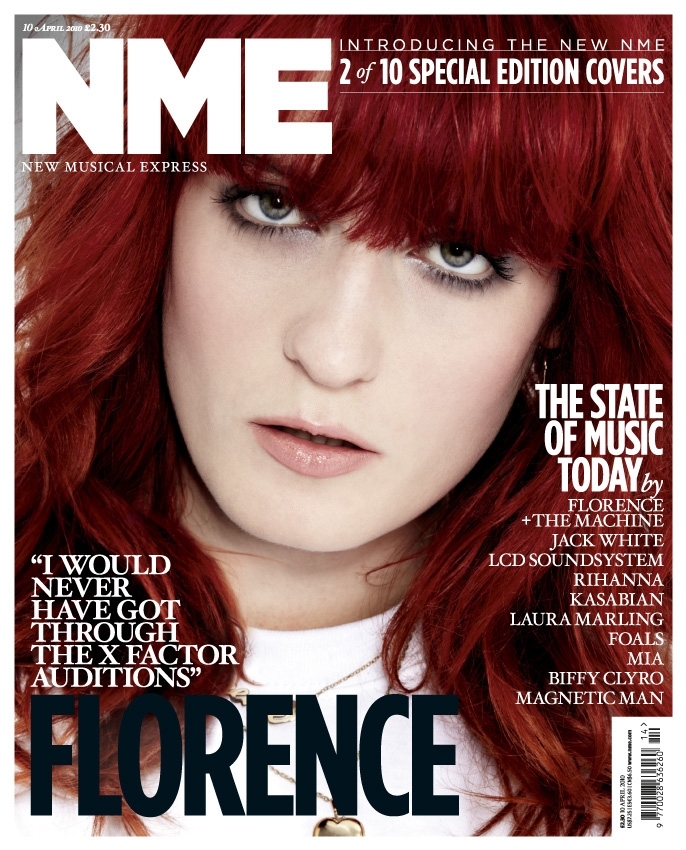
NME


NME uses a colour scheme of red, black and white throughout,
with added accents on the front cover which tie in with the main image. The use
of such highly contrasting colours creates a sense of drama around the
magazine, and also connotes passion, suggesting that the magazine is very
passionate about its content (which would make sense). It is also incredibly
eyecatching, which makes it stand out in places such as supermarkets, and is a
constant throughout most issues of the magazine, and stayed with them through
their redesign (which is advertised on the front cover). The fact that the main
image is behind all of the text and the masthead suggests that the magazine
relies heavily on its brand to sell, but the fact that the top of the main
image is also bleeding into the masthead also suggests that they are relying on
the content of their main feature in this issue to sell copies, which would
make sense as the featured artist on the front cover is David Bowie, who is
widely considered an icon within the music industry. All fonts used within the
magazine are sans serif, which creates a clean look and suggests that it is
up-to-date and modern, as sans serif fonts are often used in conjunction with
modern aesthetics and have connotations of modernity. The pose and style of the
featured artist on the front cover is quite jarring and odd, which fits in with
most people’s expectations of David Bowie as he is known for being rather
eccentric in his work. This adds to his icon status and makes people be more
likely to buy the magazine if they are a fan of him. It is easy to identify the
contents of this magazine from a glance because there is a large image of Bowie
combined with a large heading with his name on it.


On the double page spread they have continued their use of
sans serif fonts for all but the main body of text. This is because when the
font size is smaller, serif fonts are easier for the human brain to read, which
makes the article scan better for the reader. They’ve used a drop capital at
the beginning of the body of text, which draws attention to the beginning of
the article and indicates to the reader where they should begin to read the
article. They’ve also used a pull quote which gives the article substance if
the reader is just skimming through the magazine, which helps them to decide
whether or not they want to read the article. The heading of the article is in
a large, bold, font, which draws attention to the article. Its placement in the
middle of the photograph gives the photograph a clear context and easily
signifies it as part of that article. The article also has added context
because they have included a review of the featured artist’s best two tracks
off their new album, which helps someone who may not be familiar with their
work to decide whether or not they should listen to the artist after reading
the article, and it provides an opinion on their new releases which will be of
interest to people who are already fans of the artist.
Q


The main colours used in Q are the same as that of NME, bold
red, black, and white, with the occasional blue (or purple) accent. This choice
of colour scheme is eye-catching and bold, which will draw attention to the
magazine when it is displayed in a retailer. They use a slightly more subdued
red than NME, which suggests that their target audience is older than that of
NME. The use of red throughout their magazine connotes passion and drama,
suggesting both that they are passionate about their content, that the magazine
is for people who are passionate about music, and that their magazine is
exciting to read and contains drama and interesting articles. The image they
have chosen to use on the front cover of the featured artist in their magazine
is quite dramatically lit, which supports the connotations of the red motif. In
general, they use sans serif fonts, but a harsher typeface than that of NME,
with some serif fonts on the front cover and for the subheadings on the
contents page, and along with giving the magazine a harsh look, this suggests
that they aren’t as concerned with being current and up to date as NME, which
backs up the hypothesis that their target audience is older than that of NME.
On the front cover, in addition to having the image of the featured artist
bleed over into the masthead, they have also positioned the featured artist in
front of their logo, which suggests that they are relying heavily on the
featured artist to sell copies of their magazine, and can’t rely as heavily on
their brand as NME. Again on the contents page the images of the featured
artist the largest images on the page, and the cropping of one of the images
means that they are actually on top of the heading of the page, which again
suggests that they are the most exciting thing about the issue and that they
rely heavily on the artists they feature to sell the magazine. They don’t title
any of their content aside from the name of the artist it features, which is
another clue that Q relies heavily on the artists it contains as opposed to its
brand. The pose and style of the featured artists in the main image is very
sleek and suave, which will appeal to a more sophisticated audience perhaps
than that of NME. This creates the impression that Q is aimed at people who are
perhaps quite affluent and well off, or at least put an amount of effort into
their appearance. It’s easy to identify
the contents of the magazine at a glance which lets prospective readers to make
a quick decision about whether or not to pick up and read Q. It offers a broad
sense of what’s in the magazine without requiring you to open it and look at
the contents page, which again enables prospective readers to make a quick
decision about the magazine.


On the double page spread, they almost abandon the use of
sans serif fonts aside from the title and pull quote, which both use the same
font which helps to tie them together, and it is also the same font as the
cover lines on the front cover of the magazine, which gives the article a sense
of importance. They have a lot of images of the artist they’re talking about in
the article which will appeal to people who like visual articles as opposed to
ones with large bodies of text, but suggests a compromise may have been made
when it comes to the content of the article. Again the name of the featured
artist is highlighted to draw attention to the article, which may draw in
readers who were previously disinterested in the article. They have used a drop
capital to guide the reader to the beginning of the body of text, and a serif
font on the main body, possibly to aid with easier reading, but more likely
because it fits with the general style and feel of the magazine. They’ve used
effects on the images they’ve used with the article to make them seem ‘rough’
and ‘battered’, which almost creates a kind of scrapbook effect, and also
offers the reader a look at the content they’re writing about, which is a film
created by a famous musical artist. They have a connected article to the right
in a vertical banner which explores other films created by musical artists,
which will be of interest to the reader of the article, which they also use as
an opportunity to talk about more big artists. It also serves as a way for
someone who might not be interested in the main article to ‘test the water’ so
to speak, because if they’re interested or invested in an artist mentioned to
the right they will be more likely to want to read the article. The article is
very image based, which ties in with the subject of the article and also
suggests that it’s lighter reading material than may be contained in a text
heavy article because it requires less in-depth discussion.
My overall impression of Q is that it’s not as secure in its
branding as NME and perhaps relies a little too heavily on the featured artists
to sell copies of the magazine. The overall effect of the magazine is quite
effective but still a little cluttered and confusing, and there isn’t
necessarily a clear target audience as some of the content inside conflicts
heavily with the impression given by the front cover, for example images of
people dressed sharply on the front cover and then people dressed down in
jumpers and more casual clothes on the contents page gives a confusing message
about the intention of the magazine. It is designed to appeal to people who are
interested in music and popular culture, but isn’t as concerned with appealing
to a younger audience as some magazines, hence the implications of the average
reader being affluent. The magazine is intended to appeal to men. I know this
because it almost exclusively features men, and the colour scheme is commonly
associated with a male audience. It also seems to feature people who would be
aspirational figures for men. Q is published by Bauer Media Group which also
publishes KERRANG!, a music magazine aimed at a considerably younger audience
than Q. This magazine is distributed solely in the United Kingdom, despite
Bauer Media Group being based in Germany.
KERRANG!


KERRANG! use a bright, heavily contrasting colour scheme
consisting of black, yellow, white, and red. The use of yellow, red, and black,
together connotes warning and danger, suggesting that the content in the
magazine isn’t for everyone and reflects a more ‘hardcore’ genre of music than
that of NME and Q. The general style of the front cover is very rough and
deliberately offset to give the magazine the impression of being something
exciting which might have been put together very quickly. The use of all caps
cover lines gives the magazine an air of excitement and urgency, which works to
make the reader want to read the magazine and find out what’s so exciting and
urgent about the stories inside. On the contents page they have continued the
use of all caps to the categories and article titles which again contributes to
a general feeling of urgency. The contents page is quite dense and information
heavy, suggesting that most people won’t skim the magazine before reading all
the way through, or if they did so they would find it quite difficult. This
suggests that they have a dedicated readership or a brand which is prominent
enough in society for readers to know what to expect within the magazine, which
is true because they have their own TV channel and most people have at least
heard of the magazine and know the kind of content they have in their magazines
and show on their TV channel. On their contents page they have a letter from
the editor which fosters an almost personal relationship between the magazine
and the reader, which will help to create and maintain the kind of dedicated
fanbase I spoke about earlier.


On their double page spread they continue the use of all
caps in their titles and subheadings throughout the article. This creates a
sense of consistency throughout the magazine, and also works to maintain the
sense of urgency and excitement you get from their excessive use of capitals
through the magazine. It also uses words like ‘PSST’ to give the article a
sense of exclusivity, a more subtle way of doing what Q does simply by using
the word ‘exclusive’. This exclusivity is backed up by the use of the word
‘revealed’ in the article title. Like both of the other magazines I’ve looked
at, KERRANG! uses a drop capital at the beginning of the body of text to draw
in the eye of the reader and make the article easier to read. Unlike the other
magazines I’ve looked at, they have decided not to use a serif font for the
main body of text, sacrificing readability for a more modern and up to date
look which will appeal strongly to a young audience. The pose of the artists
featured in the article is that of a ‘typical band’, a pose which is instantly
recognisable to anyone who is familiar with traditional music journalism for a
younger audience, probably used to create a sense of familiarity between the
reader and the article, and make it seem as unthreatening as possible to appeal
to a younger audience. There is a particular ‘band aesthetic’ which a lot of
teenagers find appealing, and I think that they are trying to aspire to that
with this article. The combination of an unthreatening pose and obscene slogan
on a band-member’s shirt, tattoos and general ‘ruggedness’ creates an
atmosphere of safety but also introduces elements of the risqué, something
which is both useful and common among teenagers and which has traditionally
given them an opportunity to explore their sexuality in a safe environment,
usually through a crush on one of the members of a band such as this.
My overall impression of the magazine is that it wants to
create a sense of urgency and excitement through its articles through the
excessive use of all caps and exclamation marks. It appeals to a younger
audience than both of the magazines I’ve looked at previously by featuring
artists who are often the subject of teenage crushes, and again unlike the
magazines I’ve looked at previously it is intended to appeal to a female
audience, as well as, if not more than a male audience. It may not be obvious
because of the lack of feminine colours and fashion, but it appeals to a large
sect of female teenagers who deliberately do not ascribe to the societal
conventions of caring about fashion and make-up and who instead care about
bands and music. I think it is very effective in appealing to this target
audience. It does not directly address anyone who is past their teenage years
and excludes the majority of them through the simplified and subtle language
choices made and general aesthetic of excessive excitement and exclamation
marks which is often associated with teenagers, especially teenagers who are
more technologically literate and focused than their elders. KERRANG! is
published by Bauer Media Group alongside Q.